On one hand, living in Scotland during the 2016 election and the Trump presidency is nice. I’m lucky enough to be out of the fray and relatively isolated working on my project in an academic community. On the other hand, I feel a tension because I wish I could be in the US and part of a church witnessing to the truth in such a tumultuous season. Since I can’t be there to have conversations or be an activist–and despite the feeling that adding one more blog post to the internet on such topics is relatively pointless–I am going to do it anyway.
I once asked my friend Leroy Barber what he thought the unique role of the church was in area of racial reconciliation and he said peacemaking. It should be no surprise, I suppose, and I think it is true no matter the issue. The mission of God and therefore the mission of the church is reconciliation. 2 Corinthians 5:14-18 reads:
For Christ’s love compels us, because we are convinced that one died for all, and therefore all died. And he died for all, that those who live should no longer live for themselves but for him who died for them and was raised again.
So from now on we regard no one from a worldly point of view. Though we once regarded Christ in this way, we do so no longer. Therefore, if anyone is in Christ,the new creation has come: The old has gone, the new is here! All this is from God, who reconciled us to himself through Christ and gave us the ministry of reconciliation:
And Colossians 1:19 tells us that God was reconciling all things to himself in Christ. Colossians 1:19-20 in the Message has a particularly compelling description:
So spacious is he, so roomy, that everything of God finds its proper place in him without crowding. Not only that, but all the broken and dislocated pieces of the universe—people and things, animals and atoms—get properly fixed and fit together in vibrant harmonies, all because of his death, his blood that poured down from the cross.
This is always the mission of the church, and it is manifested in many ways in different times and places. This reconciliation is not a cheap “let’s all just get along” or “let’s try to move past this and work together.” It’s hard, it’s messy, it’s costly. It doesn’t ignore injustice to just move on, it disrupts and challenges the status quo. Christ poured out his life for it and that’s the path we follow. And this is true of both side of any given divide or relationship.
That’s why I love The Global Immersion Project— their goal is to teach the practice of peacemaking in the church. And though they give attention to particular global issues like immigration and the Israeli-Palestinian conflict they do so to not only raise awareness about those issues but primarily to learn from those doing the hard work of peacemaking in difficult situations so that we can apply what we learn in our own contexts.
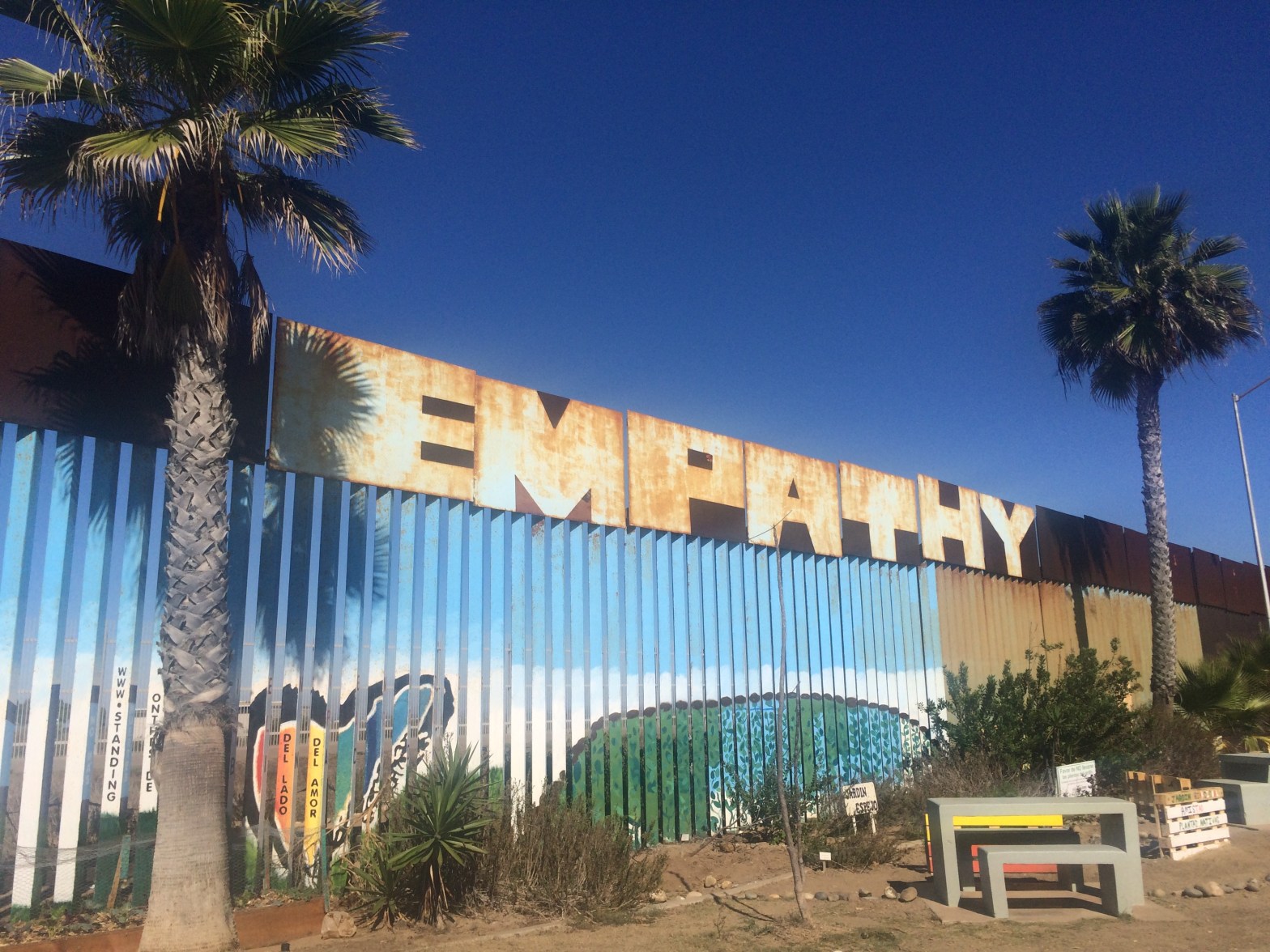
A few years ago I went on a trip with them to San Diego and Tijuana to learn about their work and to learn more about the issue of immigration in the United States. A few things I learned about the issue specifically:
- We heard stories about the lengths that people are willing to go to get to the US– being willing to sell themselves, risk abuse, and die crossing the border. That should give us a tiny glimpse of the situation that they must be coming from to be willing to risk all that.
- We heard about the pain of families separated by the wall.
- We learned that immigrants who have served in the US military can be deported and even if they are suffering debilitating disease or injury are denied reentry to the US for the medical care they need.
- We learned that much of the desperation of people trying to get to the US stems from US policies. While they were previously able to make a living in agriculture in Mexico, policies stemming from US-created NAFTA affected the prices of products and produce so that they can no longer do so. So, policies we created for the best interest of the United States forced them to cross our border and now we want to punish them.
- And we learned about a priest who serves communion when the wall at Friendship Park in Tijuana is periodically opened for families to meet, and people who build gardens in the borderlands and in slums where deportees live, and people who advocate for those caught in the system.
It should be noted that advocates of US immigration reform are not advocating for amnesty and open borders, but simply for a clear, just, accessible system that creates a reasonable way for immigrants to get into the US legally while also maintaining a secure border. Right now the system is convoluted, outdated, and privileges the rich rather than those who really need to get in. Here’s an example of of what people are asking for. If you’re interested in more resources on this issue I can definitely provide some.
Through experiences like that, The Global Immersion Project teaches their practices of peacemaking so that we can utilize it in our everyday lives. It begins by seeing others and immersing themselves in their lives and contexts. This may be with immigrants and refugees in our cities, education inequality, co-workers who aren’t like us, people in our churches who don’t believe the same thing we believe, or simply our immediate neighbors.
So in the first 100 days of the Trump presidency, I challenge you to take a step toward learning about peacemaking. Watch this free webinar (1/19/2017, password: peacemaking), sign up for their class about creating uncommon friendships, read Embrace by Leroy Barber, or find out what’s going on in your neighborhood or your. For my friends in Cincinnati, check out The Amos Project. They are organizing listening campaigns to hear about the needs of the city as well as building a network of churches who want to be sanctuaries for immigrants.
 Emily Beth Hill